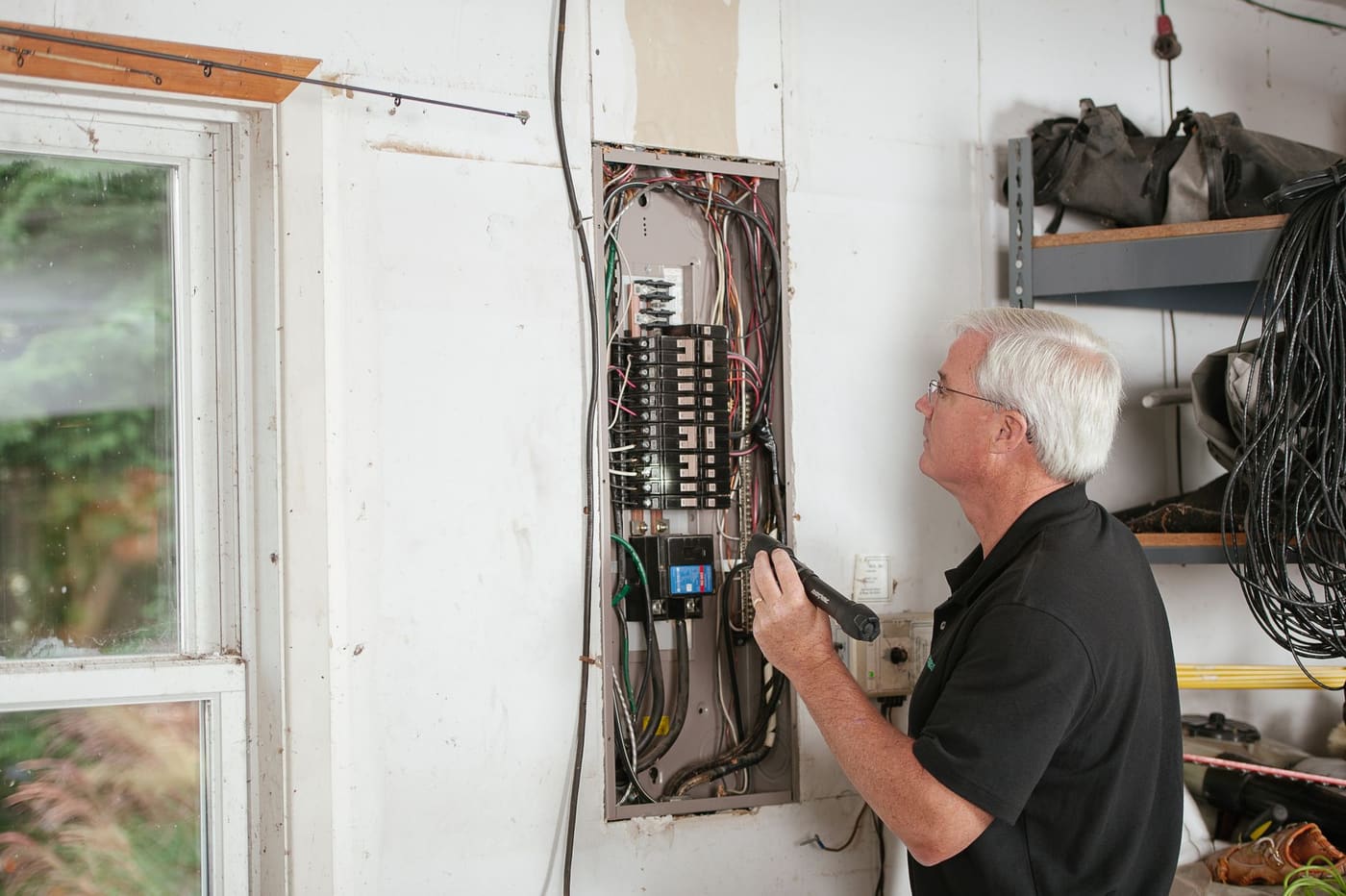
A breaker that keeps tripping in one room is usually reacting to one of four things: an overloaded circuit, a short circuit, a ground fault, or an arc fault from a damaged or loose connection. Overload is the most common and least dangerous: too many devices are drawing more current than the wire is meant to carry. A short, ground fault or arc fault points to a wiring or appliance defect, and a breaker that trips immediately, or will not reset, points that way. The breaker is doing its job, so never replace it with a bigger one.
This article explains how to tell the causes apart using checks that do not involve opening the panel, and where the safe part ends. ESFI, the Electrical Safety Foundation International, lists frequently tripped breakers among the warning signs of a possible wiring problem, so a pattern of trips is a reason to bring in an electrician, not to keep resetting.
Stop and call a licensed electrician if
These are the thresholds, so you do not have to read on to find them.
- The breaker trips immediately when reset, or will not stay on.
- The breaker, panel or an outlet is warm or hot, or buzzes or crackles.
- You smell burning or see scorch marks, melted plastic, or sparks.
- Lights flicker or dim in several places, or outlets work only sometimes.
- The trips happen after rain, near water, or in a bathroom, kitchen, garage or outdoor circuit, and moisture may be involved.
- The same breaker has tripped more than once for no clear reason.
If you smell burning or the panel is hot, switch off the affected breaker only if you can reach it safely with dry hands on dry floor, keep people away, and call. If you see smoke or flames, leave the house and call your local emergency number. If there is water on or around the panel, stay away and call your utility or an electrician.
What a breaker protects
A standard breaker is sized to the wire behind it. In most homes, 14-gauge copper wire is paired with a 15-amp breaker and 12-gauge copper with a 20-amp breaker. A 15-amp circuit at 120 volts is rated for about 1,800 watts, and a common guideline is to keep continuous loads at about 80 percent of that. If a breaker is larger than the wire, the wire can overheat before the breaker trips, which is how fires start, so a larger breaker is never a fix.
Newer panels may also use GFCI or AFCI breakers, which trip for different reasons than a standard one. The test button on the breaker face usually identifies which kind you have.
Cause 1: Overload
Overload means the total draw is above the circuit’s rating. The breaker usually trips after a delay, because heat builds up gradually. Signs:
- It trips only when specific appliances run together, such as a space heater, hair dryer, vacuum or microwave.
- It trips after the load has been on a while, not instantly.
- It resets normally and holds until the heavy load returns.
Typical culprits in a bedroom or office are space heaters, window air conditioners, hair dryers, and several power strips on one outlet. In a kitchen, a toaster, kettle and coffee maker on one circuit can exceed the limit.
What to try: unplug everything on that circuit, reset once, then plug devices back in one at a time and run the heavy ones separately. If it holds with a lighter load, spread high-draw devices across different circuits. If you regularly need more capacity than a circuit provides, an electrician can assess adding a dedicated circuit. Space heaters and similar high-draw devices should be plugged straight into a wall outlet, not a power strip or extension cord, which is a common ignition source.
Cause 2: Short circuit
A short happens when a hot conductor touches a neutral or another hot conductor, drawing a large current instantly. The breaker trips at once, sometimes with a pop. Signs:
- It trips the moment you reset it, even with everything unplugged.
- It trips when you plug in or switch on one particular item.
- You smell burning or see scorching at an outlet or cord.
If it trips with nothing plugged in, the fault is in the house wiring, a switch or a fixture, and that is a job for an electrician. If it trips only with one device, try that device on a different circuit. A damaged cord or failed motor is common, and a frayed cord should be replaced, not taped.
Cause 3: Ground fault
A ground fault occurs when a hot wire touches a grounded surface such as a metal box, a pipe or the ground wire. GFCI devices trip at very small leakage, around 5 milliamps, much lower than an ordinary breaker. Moisture is a frequent trigger. Signs:
- It trips when it rains or humidity is high.
- It trips in a bathroom, kitchen, garage or outdoor circuit.
- It trips when a certain tool or appliance is used.
Water in an outdoor receptacle, a cracked in-use cover or a wet junction box are common causes. Do not dry it out and keep resetting. If moisture is involved, leave the circuit off and have it inspected.
Cause 4: Arc faults and loose connections
AFCI breakers trip when they detect arcing, which can come from damaged wire insulation, a nail through a cable, a pinched cord behind furniture, or a loose connection at an outlet, switch or wire nut. Signs include intermittent tripping with no clear pattern, flickering lights, outlets that work only sometimes, and warm cover plates or a faint buzzing.
Some electronics and motors can cause nuisance trips on AFCI breakers, but do not assume that is the cause. A real arc fault can start a fire inside a wall. If an AFCI keeps tripping and removing a device does not stop it, have it checked.
Quick reference
| Pattern | Likely cause | First safe step |
|---|---|---|
| Trips after minutes with heavy appliances on | Overload | Reduce the load and spread devices around |
| Trips instantly on reset | Short in wiring or a fixture | Leave it off and call an electrician |
| Trips when one device is plugged in | Faulty device | Remove it and test elsewhere, or replace it |
| Trips in damp weather or wet areas | Ground fault | Keep it off and call a pro |
| Random trips and flickering | Loose connection or arc fault | Stop using the circuit and call |
| Breaker hot, buzzing or smelling | Failing breaker or bad connection | Switch off and call |
Safe steps you can take
- Find out what is on the circuit. Plug a small lamp into outlets in the room and flip the breaker to see what goes dark. Panel labels can be wrong, and a mapped circuit helps an electrician.
- Unplug everything on the circuit, including items in other rooms that share it.
- Reset once. Push the breaker fully off, then on. Do not keep resetting if it trips again, since repeated resets can hide a serious fault.
- Add loads back one at a time and note which one trips it.
- Look at outlets and cords without touching bare metal, for scorch marks, melted plastic or pinched cords behind furniture.
- Use the test button on GFCI and AFCI devices to confirm they work.
Do not remove the panel cover, do not tape a breaker on, and do not fit a higher-rated breaker. Avoid plug-in adapters that claim to add capacity.
When to call an electrician
Call one if you meet any threshold above, if you have aluminum wiring or an older panel, or if you cannot find a cause after the steps here. Costs vary by area, and a diagnostic visit is usually the right first step. Electrical problems that are not safe to DIY lists jobs that should always go to a pro, and when to call a pro instead of trying a DIY fix helps with the broader decision. Before the visit, note which room, which devices, how long between trips, and whether weather matters, using what to document before calling a home repair pro.
Where this comes from
The warning-sign guidance comes from the Electrical Safety Foundation International’s home electrical safety materials, which list frequent tripped breakers, warm outlets, buzzing, burning smells and flickering lights as reasons to call a qualified electrician. The wire and breaker pairings, the 80 percent guideline and the GFCI trip level reflect standard electrical practice and were not checked against a specific code edition, which varies by area. Appliance ratings and local rules change, so check them with a licensed electrician.